Documentation & DX / Tutorial
Rewriting a Quickstart Live: From Feature Tour to First Success in Five Steps
A step-by-step rewrite method that turns a feature-tour quickstart into a task-first guide ending in a verifiable first success.
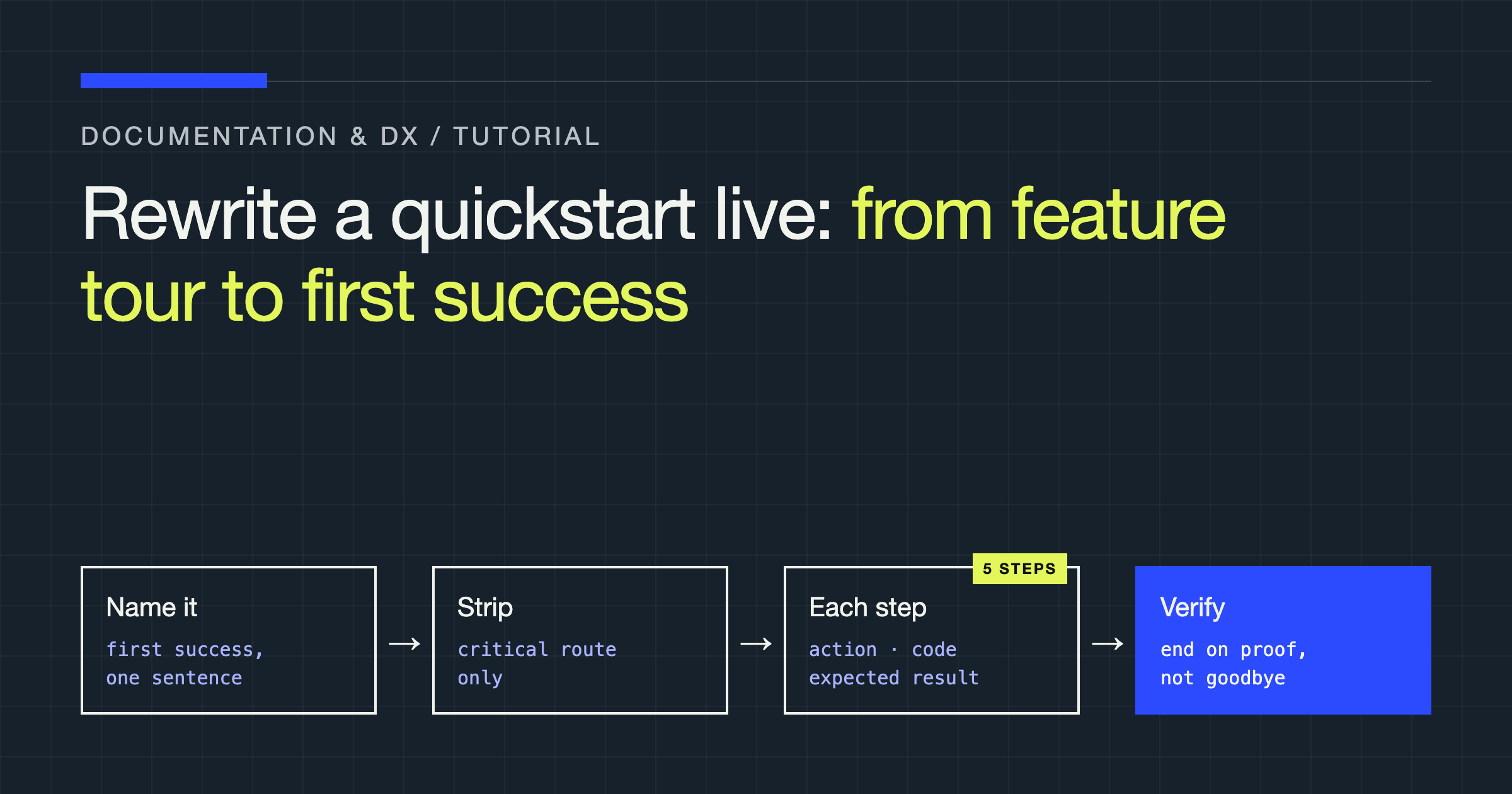
By the end of this walkthrough, you will know how to take a quickstart that reads like a guided tour of the product and rewrite it into a guide that ends with the reader having done one real thing, successfully, and knowing it worked. That is the only job a quickstart has. It is not a compressed manual, not a feature announcement, and not a place to demonstrate everything the platform can do. A reader who finishes your quickstart should have a result they can point to: a created resource, a passing request, a rendered page, a message delivered. Everything in the rewrite that follows serves that single outcome.
Diagnose the feature tour first
Most weak quickstarts fail in the same way: they are organised around the product’s architecture instead of the reader’s task. The headings name components. The steps walk through configuration screens in the order the engineering team built them. The examples show what the system can do rather than what the reader came to do. You can spot the pattern quickly. If the first screen the reader must understand is an internal concept, if the prerequisites list is longer than the procedure, or if the guide ends with “you are now ready to explore” instead of a produced result, you are looking at a feature tour wearing a quickstart’s title.
Read the existing guide once as a stranger. Mark every point where you must hold an unexplained term in your head while continuing. Mark every step where you perform an action whose purpose is not yet clear. Mark every place the guide asks for a decision, such as choosing a region, a plan, or an authentication strategy, without telling you which choice the guide itself assumes. These marks are your rewrite backlog. A good quickstart carries almost no unexplained terms, defers every decision it can, and states the default it uses whenever a decision cannot be deferred.
Step one: name the first success in one sentence
Before you touch a paragraph, write the success sentence. It follows a strict shape: “By the end of this guide, you will have” plus a verb, a concrete object, and a way to confirm it. “You will have created a project, sent your first request, and seen a successful response in your terminal” is a success sentence. “You will understand how the platform works” is not, because understanding cannot be checked and the reader cannot tell whether they have arrived.
This sentence does three jobs. It becomes the opening line of the rewritten guide, so the reader can self-select in seconds. It becomes the acceptance test for every later step: if a step does not move the reader toward that sentence, it leaves the quickstart and goes to a tutorial or a concept page. And it becomes the closing verification, because the guide ends by returning to exactly the result the sentence promised. Resist the urge to promise two successes. One finished thing teaches more than three half-finished ones, and the reader who completes one guide willingly starts a second.
Step two: strip the path to the critical route
Lay the old guide’s steps out and sort them into three piles. The first pile is the critical route: actions without which the promised result cannot happen, such as creating an account resource, generating a credential, installing the client, and making the call. The second pile is explanation: what a token is, how billing works, how the architecture fits together. The third pile is variation: other languages, other frameworks, other authentication methods, production hardening.
The rewritten quickstart keeps the first pile, in order, complete. The second pile shrinks to the minimum context each step needs at the moment it is needed, ideally a single sentence attached to the step it supports, with a link for readers who want depth. The third pile leaves entirely and becomes links at the end under an honest heading such as “Next steps”. This is the step writers resist, because the removed material is usually accurate and hard-won. Keep it, but keep it elsewhere. A quickstart is a route, not a warehouse, and every accurate paragraph that is not on the route is still an obstacle on the route.
Step three: rewrite each step as action, code, expected result
Each step in the new guide follows the same three-beat pattern. First, one sentence that says what you are about to do and why it matters to the promised outcome. Second, the exact command, request, or console action, complete and copyable, with the reader’s own values clearly marked as placeholders. Third, what the reader should see if it worked: the shape of the output, the status returned, the resource that now exists.
The third beat is where most quickstarts silently fail their readers. A step that says “run the command” and moves on leaves the reader unable to distinguish success from a plausible-looking error. Show the expected result, trimmed to the lines that matter, and name the signal to look for. Where a step commonly breaks, say so at the step, in one line, with the fix: not a troubleshooting appendix the reader must already know they need, but a sign placed exactly where people fall.
| Element | Feature-tour version | Task-first rewrite |
|---|---|---|
| Opening | Lists what the platform offers | States the one result the reader will produce |
| Prerequisites | Everything a full setup might need | Only what this route requires, with defaults chosen |
| Steps | Screens and concepts in product order | Actions in dependency order, each with an expected result |
| Code | Illustrative fragments | Complete, copyable, placeholder values marked |
| Ending | Invites the reader to explore | Verifies the promised result, then links onward |
Step four: move decisions out of the reader’s way
Every decision a quickstart forces is a place readers stall, compare options they cannot yet judge, or pick the branch your examples do not cover. Audit the route for decisions and handle each one in one of three ways. Defer it: if the choice only matters in production, use the simplest option now and say so. Default it: state plainly “this guide uses the hosted option; the self-hosted path is covered in the deployment guide.” Or split it: if two audiences genuinely diverge at this point, the quickstart should commit to one and link the other, because a branching quickstart is two guides fighting in one page.
Credentials deserve special discipline. Tell the reader exactly where the value comes from, what it will look like in the guide, and where it must never go. “Create a key in the dashboard and store it as an environment variable; the examples read it from there, so you will never paste the real value into code” prevents the two commonest quickstart accidents: readers hunting through settings pages, and readers hardcoding secrets into files they later commit.
Step five: end with verification, not a wave goodbye
Close the guide by returning to the success sentence and proving it. Give the reader one final action that can only succeed if everything along the route worked: fetch the resource you created, check the status of the job you submitted, load the page you deployed. Show the expected output one last time and say, in plain terms, “if you can see this, the setup works.” Then, and only then, offer the onward links: the tutorial that extends the result, the concept page that explains what they just used, the reference for the endpoints they touched.
This ending also gives you a maintenance instrument. When the product changes, the verification step is the first thing that breaks, and a broken verification is unambiguous in a way that stale prose is not. Test the quickstart by running it, literally, from a clean state, and treat any moment where you relied on knowledge the page does not contain as a defect in the page, not in the reader.
What to do with everything you cut
Cutting is not deleting, and the rewrite will go better if the removed material has a declared destination before you start. Explanation belongs in concept pages, where a reader who wants the model behind the tool can absorb it at their own pace. Variations belong in tutorials, each of which can assume the quickstart’s result as its starting point and commit fully to one audience, one framework, one deployment target. Production concerns, scaling, hardening, and cost, belong in guides written for readers who already have something running. When you move a paragraph, note where it went, and add the link from the quickstart’s closing section only if a reader finishing the route would plausibly want it next.
This discipline protects the rewrite politically as well as editorially. Stakeholders who see their favourite content “removed” resist; stakeholders who see it relocated to the page where it will actually be read, with the quickstart linking onward, usually do not. The goal was never less documentation. It is the same documentation, sequenced so that each page does one job and the first job gets done first.
The rewrite checklist
Before you publish the rewrite, walk it against the promises you made. The opening states one result in one sentence. Every prerequisite earns its place on this route specifically. No step requires an unexplained term. Every command is complete and copyable. Every step shows its expected result. Every decision is deferred, defaulted, or split. The ending verifies the result and only then links onward. If any item fails, the guide is not finished, however polished the prose feels.
Verdict
Rewrite the quickstart around a single, checkable success and be ruthless about everything that is not on the route to it. Move explanation to concept pages, variations to tutorials, and decisions behind stated defaults. The feature tour feels generous and reads as thorough, but it asks the reader to fund your completeness with their momentum. The task-first guide is shorter, stricter, and far more respectful: it gives the reader a working result, proof that it works, and a reason to trust the rest of your documentation.