Documentation & DX / Docs teardown
Auditing a Developer Onboarding Funnel: Signup to First API Call, Timed and Scored
A repeatable audit method for the developer onboarding funnel, with a scoring rubric and a clearly labelled illustrative walkthrough.
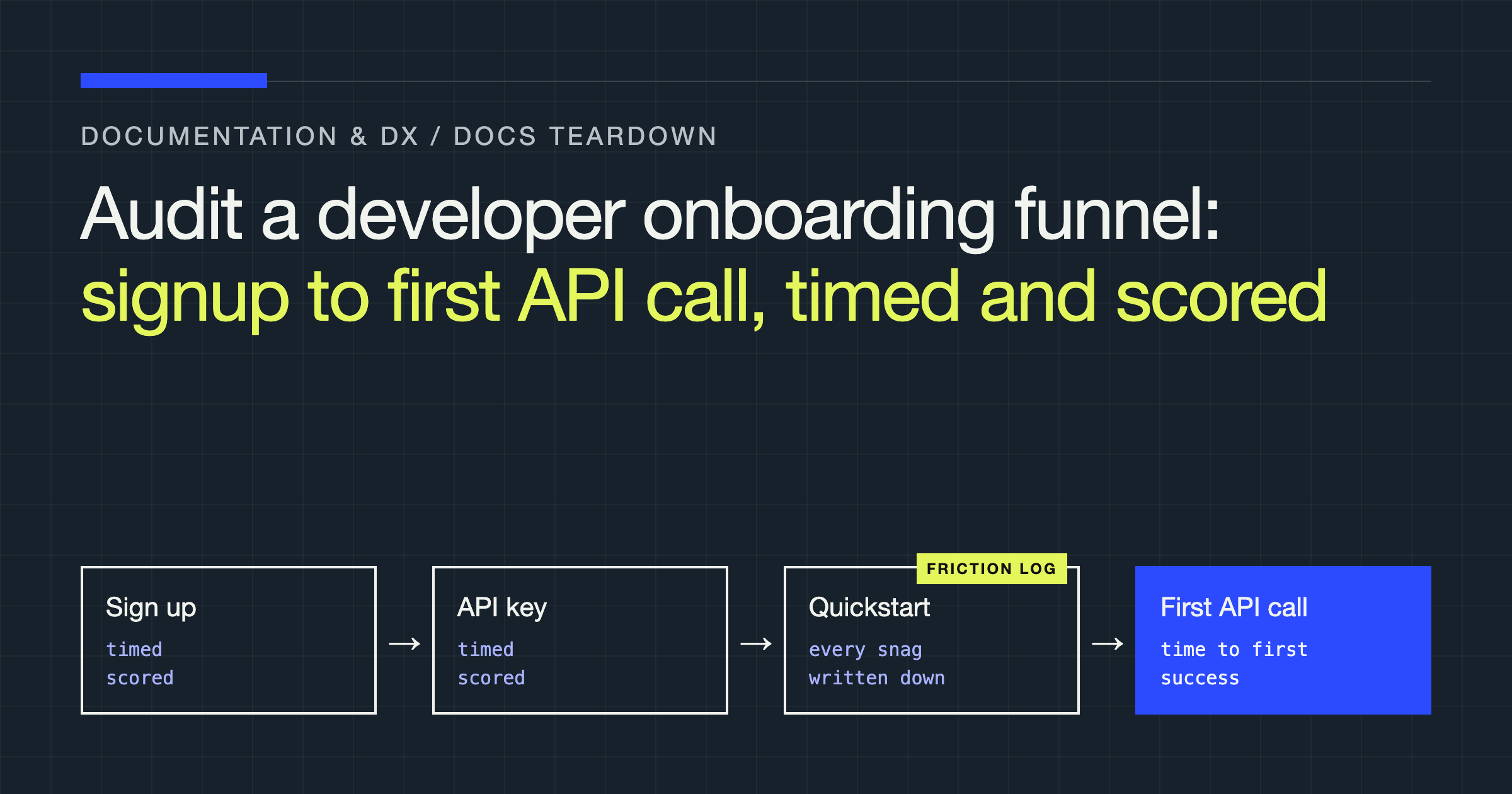
By the end of this piece, you will have a repeatable method for auditing a developer onboarding funnel, the path from landing on the signup page to a first successful API call, and a scoring rubric you can apply consistently across audits. To keep the method honest, the walkthrough later in this piece is an illustrative example built on a hypothetical product, with invented timings and scores labelled as such. It demonstrates how the audit runs and how findings are recorded. It is not a report on any real company’s funnel, and you should treat any audit that does not show its working with the suspicion this one is designed to help you apply.
Why audit the funnel as a funnel
Developer onboarding fails cumulatively. No single step in a typical funnel is broken enough to stop a determined developer; instead, small frictions stack: an unclear plan choice here, a credential hidden in an unexpected screen there, an example that needs one undocumented adjustment. Each costs a little confidence, and developers abandon the sequence at the point where the accumulated doubt exceeds their reason for starting. Reviewing pages one at a time, which is how documentation is usually reviewed, cannot see this, because every page passes its own review. The audit must therefore walk the whole path as one journey, in order, under time pressure, exactly as a new user experiences it.
That is why the method uses a clock and a score. The clock surfaces friction that prose review normalises: a step you have performed many times feels instant until you watch a stopwatch while a newcomer-equivalent run hunts for the API key screen. The score forces comparability. Without it, every audit dissolves into a list of opinions that the owning team can rank by how much they sting. With it, you can say which stage of the funnel is weakest, whether a redesign improved the stage it touched, and where the next unit of documentation effort buys the most recovered users.
Set the rules before you start
An audit is only repeatable if its conditions are fixed in advance. Define the persona precisely: a developer competent in the stack the product targets, with no prior exposure to this product, working from the public documentation alone. Define the environment: a clean account, a fresh browser profile, no insider links, no help from colleagues, and no searching the web for answers the docs should contain, because every external rescue is a funnel failure you are choosing not to count. Define the finish line exactly: the first successful API call, meaning a request the product accepts that returns the expected result for a trivial read or create, performed with credentials the funnel itself issued.
Decide your assistance rules too. The auditor may follow any link the funnel offers, including in-product guidance and documentation, because a real user would. The auditor may not ask support, may not inspect page source for hidden answers, and may not use knowledge from previous audits of the same product. When the auditor is genuinely blocked, the audit records the block, the stage it occurred in, and the time spent before abandoning or working around it. A block is the most valuable finding an audit produces; do not launder it into a slow success.
The stages, and what each one is scored on
Divide the journey into five stages: discover and decide, create the account, obtain credentials, set up the environment, and make the first call. Score each stage on four dimensions, each from one to five. Clarity: could the auditor always tell what to do next and why? Friction: how many unnecessary fields, decisions, detours, and waits did the stage impose? Guidance: did the product explain itself at the point of need, or leave the auditor to guess? Recovery: when something went wrong or was unclear, did the funnel help the auditor back onto the path? A stage score is the average of its four dimensions, and the funnel score is the average of the stages, but report the stage scores individually. A single funnel number hides the finding; the stage profile is the finding.
Timing runs alongside scoring. Start the clock at the beginning of each stage and record elapsed time at each stage boundary. You are not chasing a universal benchmark; you are looking for disproportion, the stage that consumes time out of keeping with the value it delivers, and for dead time inside stages, where the auditor was reading, hunting, or waiting rather than progressing. Record also a simple count of avoidable decisions and of documentation excursions, moments the auditor had to leave the flow to find an answer elsewhere.
| Stage | What gets scored hardest | Typical failure the audit catches |
|---|---|---|
| Discover and decide | Clarity of the offer and the plan choice | Pricing or plan gates revealed only after signup begins |
| Create the account | Friction in fields and verification | Verification delays with no explanation or progress signal |
| Obtain credentials | Guidance to the key and safe storage | Keys buried in settings, shown once, with no storage guidance |
| Set up the environment | Clarity of prerequisites and install path | Undocumented version requirements discovered by failure |
| First call | Recovery when the first request fails | Example code that needs undocumented adjustment to run |
Run the audit and keep a friction log
During the run, the auditor narrates into a friction log: every hesitation, every backtrack, every moment of re-reading, every error. Entries are timestamped against the stage clock and written in plain language, quoting the screen or the document where the friction occurred. The log matters more than the scores, because it is where the fixes live. “Credentials stage scored two for guidance” is an opinion a team can debate. A log entry recording that the auditor opened three settings screens looking for the key, which sat under a label using none of the words the documentation used for it, is a fix a team can schedule.
Resist fixing anything during the run. The auditor’s job is to complete the funnel as the user must, taking the workarounds a user would plausibly find and recording the ones they would not. Afterwards, convert the log into findings, each tied to a stage, a dimension, and the exact evidence from the log. Group findings by stage, rank within each stage by the time and doubt they cost, and separate funnel defects, which the product team owns, from documentation defects, which the writing can fix directly. The audit’s credibility rests on this discipline; an audit that arrives as a blended list of complaints gets treated as one.
Illustrative walkthrough: the method applied to a hypothetical product
Everything in this section is an illustrative example. The product, “Northgate API,” is invented for this walkthrough; the timings and scores are invented with it, chosen to show how an auditor records and reasons. No real funnel was timed here, and nothing below is evidence about any actual company.
Suppose the auditor begins. In the discover stage, the clock runs while the auditor reads the overview and reaches the plan decision, where the illustrative friction log notes two plan names whose difference is never explained in task terms, so the auditor picks by price alone. The auditor scores clarity two, friction three, guidance two, recovery three, a stage average of two and a half, with an illustrative elapsed time recorded as the longest of the early stages despite the stage containing no technical work at all.
The account stage, in this example, is the funnel’s best: a short form, an immediate verification, and a progress cue that says what happens next, scoring fours across most dimensions. Credential retrieval then collapses: the illustrative log records the auditor hunting through settings because the documentation says “your API key” while the interface labels the destination with the product’s internal term for credentials, and the key, once found, is displayed with no guidance on storing it. Guidance scores one. Setup proceeds cleanly from a stated prerequisites list, and the first call fails once because the illustrative example omits a header the reference documents elsewhere; the auditor recovers by following an error message that, creditably, names the missing header, which lifts recovery to four while guidance stays low.
The audit report for this invented funnel would lead with the stage profile, not the blended average: one strong stage, one broken stage, and a first-call stage whose error writing is quietly saving the funnel from its own examples. The recommendations follow the profile: align the documentation’s vocabulary with the interface’s labels, explain the plan difference in task terms before signup, and fold the missing header into the example. Note what the method produced here: findings a page-by-page review would have missed, because the vocabulary mismatch only exists between pages, and the plan ambiguity only hurts before the account exists.
Verdict
Audit the funnel as one timed, scored journey, run by the rules of a stranger, and let a timestamped friction log carry the evidence. Score by stage and dimension, report the profile rather than a single number, and keep illustrative reasoning clearly separated from measured findings whenever you present the method. The funnel is where documentation, product design, and writing meet the user’s first hour. It deserves the most rigorous review you own, because every improvement there compounds across every user who arrives after.