APIs & developer platforms / Tutorial
Designing Rate Limits Developers Won't Hate: Quotas, Headers, and Graceful 429s
Design rate limits that protect your API without punishing good clients: fair quotas, honest headers, and 429 responses developers can act on.
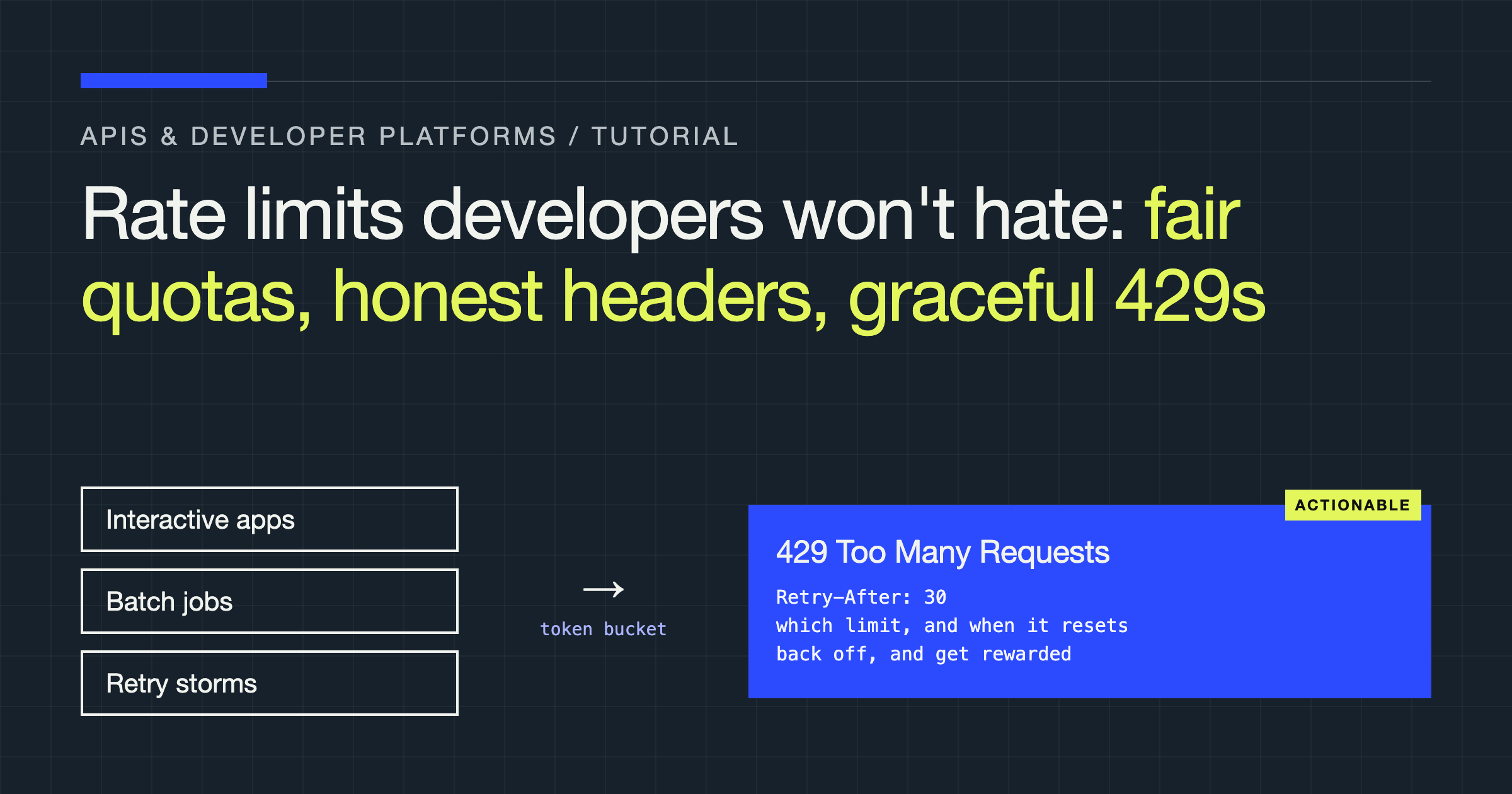
You will design a rate limiting system that protects your infrastructure and still feels fair to the developers building on it. That means choosing what to limit, picking an algorithm whose behaviour you can explain, telling clients exactly where they stand on every response, and returning a 429 that a developer can act on at midnight without opening a support ticket.
Rate limits fail in two opposite ways. Set them carelessly and a runaway script takes your service down for everyone. Set them opaquely and your best clients hit invisible walls, guess at the rules, retry aggressively, and make the load worse while concluding your platform is unreliable. The goal is not the strictest limit you can enforce. It is a limit that is predictable, visible, and proportionate, enforced consistently enough that well-behaved clients never have to think about it.
Decide what you are actually protecting
Start with the resource, not the number. Every limit defends something specific, and the right unit follows from that.
- Expensive computation or downstream cost. Limit requests per client on the costly endpoints, not the whole API uniformly. A cheap read and an export that scans a large dataset should not share a quota.
- A scarce shared resource. If all clients draw on one downstream system with its own capacity, your limit is really an allocation problem. Per-client fairness matters more than a global total.
- Abuse and credential stuffing. Authentication endpoints need limits keyed differently, by account and by network origin, with lower tolerance and faster escalation.
- Noisy neighbours. Per-client limits stop one integration’s bug from becoming everyone’s outage. This is the most common and most defensible reason to limit a public API.
Naming the resource exposes a mistake teams make constantly: limiting by IP address as the primary key for an authenticated API. Many legitimate clients share an IP through corporate gateways and NAT, and one misbehaving user behind that address then blocks an entire company. For authenticated traffic, limit by the credential or account that made the call. Reserve IP-based limits for unauthenticated and authentication endpoints, where you have nothing better.
Also decide the cost of a request, not just its count. If one endpoint is dramatically more expensive than others, count it more heavily against the quota or give it its own bucket. A single flat count invites clients to discover that the expensive call is unpriced, and it invites your own team to discover it during an incident.
Pick an algorithm you can explain to a client
Every algorithm is a tradeoff between accuracy, burst behaviour, and how simply you can describe it in your documentation. If you cannot explain the rule in two sentences, clients cannot code against it.
| Algorithm | Behaviour | Burst handling | Implementation notes |
|---|---|---|---|
| Fixed window | Allows a set number per clock window, then resets | Permits a double-sized burst across a window boundary | Simplest to implement, hardest to defend as fair |
| Sliding window | Counts requests over a rolling window | Smooths the boundary burst | More state or estimation to maintain |
| Token bucket | Tokens refill steadily, requests spend them | Allows controlled bursts up to bucket size | Forgiving of legitimate spikes, easy to reason about |
| Leaky bucket | Requests drain at a constant rate | Smooths bursts into a steady stream | Can add latency if you queue rather than reject |
For most public APIs, a token bucket or a sliding window is the right default. A token bucket matches how real clients behave: quiet for a while, then a legitimate burst when a job runs or a page loads several resources at once. Punishing that burst with a fixed window teaches clients to spread load artificially or to retry, both of which are worse for you.
Fixed window remains acceptable for coarse, high-level quotas such as a monthly allowance, where the boundary effect is a minor concern over a long period and simplicity of accounting is the point. Do not use it as your only defence on short windows protecting live capacity.
Whatever you choose, enforce it in one shared place. If each server instance keeps its own counters, your effective limit becomes the configured limit multiplied by the number of instances, and it changes when you scale. Short-window limits protecting capacity belong in a shared store consulted by every instance, or enforced at a gateway in front of them. Instance-local limiting is a reasonable last-resort overload shedder. It is not a quota system.
type Bucket = {
  tokens: number;
  updatedAt: number; // milliseconds
};

type Decision = {
  allowed: boolean;
  limit: number;
  remaining: number;
  retryAfterSeconds: number;
};

export function takeToken(
  bucket: Bucket,
  now: number,
  capacity: number,
  refillPerSecond: number,
  cost = 1
): Decision {
  const elapsedSeconds = Math.max(0, (now - bucket.updatedAt) / 1000);
  const refilled = Math.min(
    capacity,
    bucket.tokens + elapsedSeconds * refillPerSecond
  );

  if (refilled < cost) {
    const deficit = cost - refilled;
    return {
      allowed: false,
      limit: capacity,
      remaining: 0,
      retryAfterSeconds: Math.ceil(deficit / refillPerSecond),
    };
  }

  bucket.tokens = refilled - cost;
  bucket.updatedAt = now;

  return {
    allowed: true,
    limit: capacity,
    remaining: Math.floor(bucket.tokens),
    retryAfterSeconds: 0,
  };
}
In production this logic runs atomically in your shared store, typically as a script or a transactional update, so two concurrent requests cannot both spend the same token. The shape of the decision matters as much as the arithmetic: every check returns the limit, the remaining allowance, and, when rejected, exactly how long to wait. You will need all three for your headers and your error body.
Set quotas by client behaviour, not by round numbers
A quota pulled from thin air will be wrong in both directions at once: too low for your heaviest legitimate client and too high to protect you from the pattern you actually fear. Derive it from observation instead.
Measure your real clients first, in illustrative terms rather than invented precision: most integrations use a small fraction of what a runaway loop generates, and the gap between normal behaviour and a bug is usually enormous. Set the limit comfortably above the high end of legitimate behaviour you observe, including seasonal and job-driven spikes, so that normal success never triggers it, and treat the limit as an abuse and accident boundary rather than a shaping tool. Then set a separate, much more sensitive alert for your own team at a lower threshold, so you hear about a client trending upward before they hit the wall.
Tier quotas deliberately if your product has tiers, and make the tiers mean something operationally. A paid tier that raises the limit should also raise it enough to change what a client can build, not by a token amount that reads as an upsell rather than capacity. Always provide a path to a higher limit for legitimate use, even if that path is a conversation. A client building something real who hits your ceiling and finds no door will leave, and will describe the experience accurately in public.
Separate short-window burst limits from longer-window quotas, and document both. A client planning a migration or a backfill needs to know the sustained rate they can run at, not just the burst they can spike to. Backfills are the classic legitimate pattern that looks exactly like abuse. Give clients a way to do them: a documented sustained rate, a bulk endpoint, or a scheduled window. Otherwise your limiter will spend its life fighting your most serious users.
Tell clients where they stand, on every response
Rate limit headers are not decoration. They are how a well-built client regulates itself before it ever reaches your limit, which is precisely the behaviour you want to reward.
Return, on successful responses as well as rejections:
- The limit for the window or bucket the request drew from.
- The remaining allowance after this request.
- When the allowance resets or refills, expressed so a client can compute a wait without guessing.
Use the header names your API already documents and keep them consistent across every endpoint. Inconsistent headers between resources are worse than minimal ones, because a client will build its throttling logic against one endpoint and then misread another.
When limits differ by endpoint cost, the headers must reflect the bucket actually charged. A single global-looking number that silently means different things on different routes teaches clients to distrust it, and they will go back to guessing.
Make the 429 worth reading
A rejected request gets the standard 429 status. What separates a tolerable limit from a hated one is the body and the timing guidance that come with it.
Your 429 response must include a retry-after value, in the header designed for that purpose, expressed in seconds. A client that knows how long to wait can schedule a single retry. A client that does not will guess, and most guesses are short, which converts one rejected request into a burst of premature retries aimed at a system that just told it to slow down.
The body should be a structured error in the same format as every other error your API returns, with a stable machine-readable code, a human-readable message that names the limit that was hit, and the same limit and remaining values as the headers. Never return an HTML error page or an empty body from an API rejection. Client code cannot parse your web framework’s default error page, and the developer debugging it will remember that.
{
  "error": {
    "code": "rate_limit_exceeded",
    "message": "Rate limit exceeded for this credential. Retry after the interval given in the Retry-After header.",
    "limit": 0,
    "remaining": 0,
    "docs": "https://example.com/docs/rate-limits"
  }
}
The numeric fields in that example are illustrative placeholders for the values your limiter computed for that specific request, not published quotas. In a real response they always come from the decision your limiter just made, so the body, the headers, and the enforcement never disagree.
Also consider the client you cannot see. Some clients are scheduled jobs and integrations whose operator will only learn about repeated rejections from your error logs or their own. Consistent error codes let both you and them alert on rate limit failures as a distinct condition, rather than discovering them weeks later as mysteriously missing data.
Teach clients to back off, and reward it
Document the retry behaviour you want, explicitly, with an example. Ask for exponential backoff with jitter, honouring your retry-after value as the floor. Jitter is not a nicety. Without it, every client rejected in the same moment retries in the same moment, and your recovery from an overload becomes a series of synchronised waves. With it, retries spread across the window and the system settles.
Do not count a rejected request against the client’s quota in a way that extends their penalty for retrying politely, and never let a client talk themselves into a longer lockout by following your documentation. Penalties should decay with the window or bucket refill and nothing else.
Finally, keep a distinction between rate limiting and concurrency limiting. A client can be well under your request rate while holding many slow requests open at once, and that pattern exhausts connection pools and worker capacity in a way a rate counter never sees. If your service has long-running requests, limit in-flight concurrency per client as well, and document it as the separate control it is.
Verdict
Limit by authenticated identity, not by IP, and weight the endpoints that actually cost you. Use a token bucket or sliding window for live protection so legitimate bursts survive, enforced once in a shared store with a deliberate failure mode. Set the numbers comfortably above observed legitimate behaviour, tell clients their limit and remaining allowance on every response, and answer rejections with a real retry-after value and a structured error.
Developers do not hate rate limits. They hate surprises, silence, and penalties they cannot predict or appeal. A limit they can see coming, code against, and recover from on a timer you gave them is simply part of a professional API, and they will build around it without resentment.